
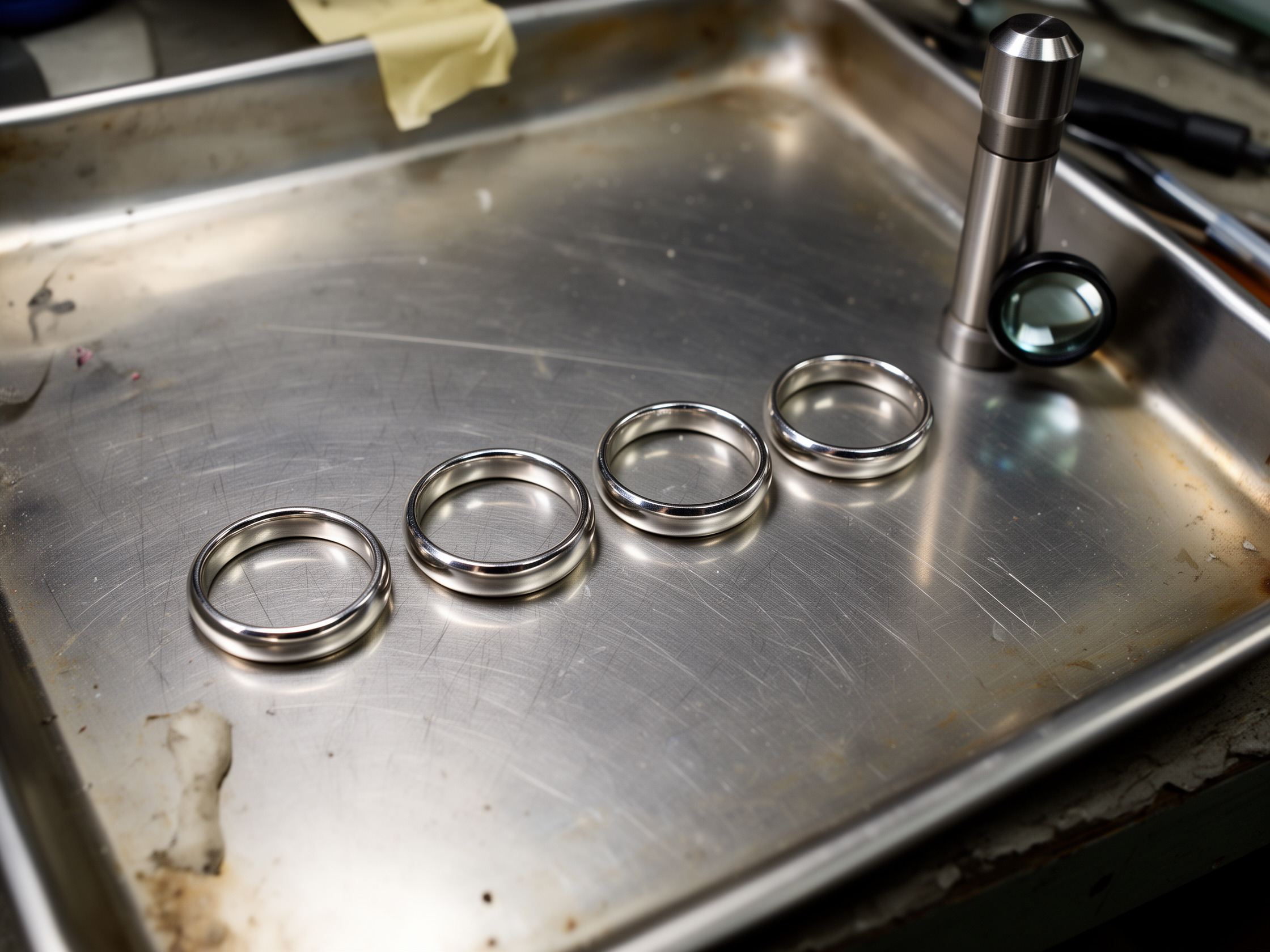
Read the hallmark first
Look for 925, sterling, or STER on the piece, usually inside a ring band or on a clasp tag. These indicate 92.5 percent silver.
A hallmark is a declaration, not a proof. It can be stamped on anything, so treat it as the first filter rather than a conclusion.
Country marks and maker marks are worth recording. Consistent marks across a lot suggest a controlled production line; missing or inconsistent marks are a reason to ask more questions.
Understand what a magnet can and cannot show
Silver is not magnetic. If a magnet pulls strongly, the piece contains iron, nickel or another ferromagnetic metal and is not solid silver.
A magnet that does nothing proves very little. Copper, zinc and brass are also non-magnetic, and those are exactly what plated silver is often made from.
For plated stock the magnet test answers neither question. It will not confirm silver content and it will not reveal plating.
Weight and oxidation as supporting signals
Silver has a density of about 10.49 grams per cubic centimetre, so a silver piece feels heavier than the same volume of plated brass. Feel is useful for comparison, not for measurement.
Tarnish on silver is usually brown to black and appears as a film. Plated brass can discolour differently, and a peeled edge showing a different colour underneath indicates plating over a base metal.
Neither signal is decisive. Both are reasons to run a proper test, not replacements for one.
Use XRF for a real answer
X-ray fluorescence measures the elements in a piece without damaging it. It reports silver content and can show the presence of a plating layer.
It is the practical way to verify a production lot. Asking a supplier for a recent XRF report on a specific SKU is a normal request, not an accusation.
Read the report by lot or date, not as a one-off document. A result from two years ago says nothing about the batch being shipped now.
Ask for documents and keep samples
Request a material declaration naming 925 silver and the plating type, plus the test reports that apply to the SKU: nickel release, lead and cadmium where relevant.
Keep an approved sample from each production run. It is the cheapest way to settle a dispute about colour, weight or finish later.
For repeat orders, compare the new lot against the stored sample before bulk arrives. Drift is easier to catch on one piece than on a container.